Covers environment, transportation, urban and regional planning, economic and social issues with a focus on Finland and Portugal.
Showing posts with label culture. Show all posts

Tuesday, September 21, 2010

Alentejo: Two Portraits


Chronicle - "A Minha Terra Está Triste" - Article published in the "Diario do Alentejo"  in the early 70s, about human desertification.  (via patrimonio89)
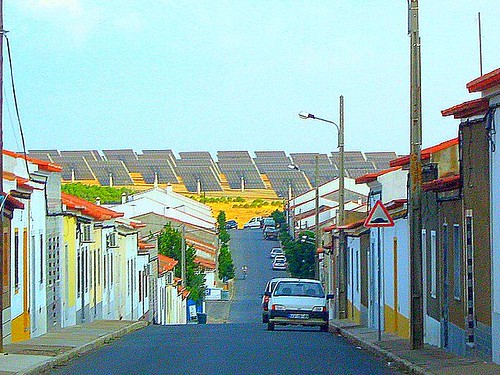
   IMG_2586B
 Photovoltaic Power Station in  Amareleja (Moura, Alentejo region, Portugal, 2008)  by  mokkikunta

allvoices

Sunday, August 29, 2010

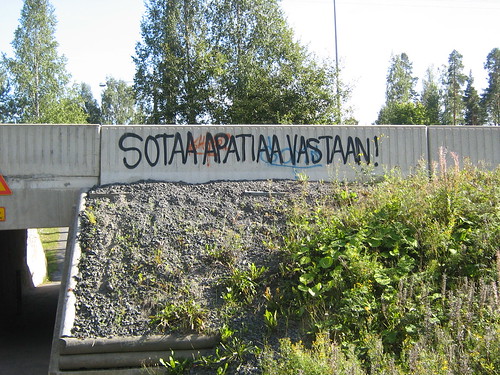
War Against Apathy

IMG_4676
Sotaan Apatiaa Vastaan        
War Against Apathy 
Guerra Contra a Apatia 
Guerre Contre l'Apathie

allvoices

Tuesday, July 13, 2010

Uma estratégia pouco artística

Intolerable Beauty: Portraits of American Mass Consumption(2003 - 2005) - Circuit boards #2, New Orleans 2005 by Chris Jordan

A 24 de Março de 2010, o Teatro Fórum de Moura, estrutura artística e cultural alentejana, reagiu à primeira (Jornal Público, 24/3/2010) de uma série de entrevistas da Ministra da Cultura Gabriela Canavilhas, lançando um comunicado intitulado “Cai a Máscara à Ministra Gabriela” . Essa entrevista de Gabriela Canavilhas teve como pretexto a apresentação dum estudo da empresa Augusto Mateus & Associados sobre “O Sector Cultural e Criativo em Portugal” liderado por Augusto Mateus, O documento foi elaborado, na sequência de uma encomenda do Gabinete de Planeamento, Estratégia, Avaliação e Relações Públicas do Ministério da Cultura. 


Contrariamente às ”Grandes recomendações (Cultura e Competitividade)” do estudo,  não nos parece que o ”desafio central para as políticas públicas de dinamização do SCC"( Sector Cultural e Criativo)   se situe mais no ”terreno do contributo da cultura e da criatividade para a renovação e relançamento dos modelos competitivos das empresas” , do que no ”terreno do equilíbrio da cobertura territorial do país em matéria de equipamentos e infra-estruturas de índole cultural”. E quando o documento faz referência a modelos competitivos das ”regiões portuguesas”,  a que regiões se refere? Em Portugal Continental não existem Regiões Administrativas. Portanto, näo vale a pena definir um verdadeiro "desafio central" do SCC português, sem nele incluir e preconizar a ”regionalização ” do país (e do SCC por consequência). 

O que vivemos, actualmente, é uma profunda desigualdade territorial e um enorme desequílibrio entre a área social e a área económica. De facto, o que as grandes corporações sabem fazer é investir milhões de euros em produtos culturais massificadores de fraca qualidade. A função social das artes e da cultura é decisiva para um desenvolvimento sustentável do território. O ”produto cultural” não pode ser encarado como uma mera ”mercadoria” duma economia capitalista. É muito mais do que isso - é um espaço social de trabalhadores com direitos, é um espaço de liberdade de criação e de expressão e  é um espaço onde deve ser garantida a acessibilidade de toda a população aos meios de produção e fruição cultural. 

Sem dúvida que  ao longo das últimas décadas, os trabalhadores das artes e da cultura criaram estruturas, adquiriram meios de produção próprios, desenvolvendo um trabalho de serviço público descentralizado, na sua grande maioria substituindo-se ao Estado na responsabilidade de assegurar uma política cultural em todo o território nacional.

E o que a Gabriela Canavilhas não pode esquecer é aquilo que está previsto no artigo 78 da Constituição da República Portuguesa  (Fruição e criação cultural): 

2. Incumbe ao Estado, em colaboração com todos os agentes culturais: 
a) Incentivar e assegurar o acesso de todos os cidadãos aos meios e instrumentos de acção cultural, bem como corrigir as assimetrias existentes no país em tal domínio; 
b) Apoiar as iniciativas que estimulem a criação individual e colectiva, nas suas múltiplas formas e expressões, e uma maior circulação das obras e dos bens culturais de qualidade; 
c) Promover a salvaguarda e a valorização do património cultural, tornando-o elemento vivificador da identidade cultural comum;  
d) Desenvolver as relações culturais com todos os povos, especialmente os de língua portuguesa, e assegurar a defesa e a promoção da cultura portuguesa no estrangeiro; 
e) Articular a política cultural e as demais políticas sectoriais 

A grave crise da dívida pública do estado português constitui uma oportunidade para a classe social dominante  acelerar o processo de controle social e cultural. A "destruição criativa"  neo-liberal - típica das políticas  que  têm conduzido ao enfraquecimento e colapso das instituições, segurança social, saúde, educação e cultura - não é mais do que a máscara da destruição do nossa rede social e cultural, a nível local . E para essa actuação "sectorial" o governo central parece já ter uma "artista", apoiada numa estratégia pouco artística.

allvoices

Tuesday, November 18, 2008

Kaisla Arts and Crafts

Kaisla shop gallery (Kaisla kauppa galleria) is a rectangular two-story old house with solid red-brick walls and interior open spaces, nicely situated at the port of Korpilahti, Central Finland (Korpilahden satama, Keski-Suomi), which offers the Päijänne lake beautiful landscape. The first floor has the arts & crafts shop function, revealing many pieces of local artists and the second floor is a single room gallery for artworks exhibition.

Read more


Last summer - in a particularly rainy and thunderstorming August (elokuu) in that Finnish region - my friend Haukka and I visited Kaisla. However, this time we’ve noticed there an open book with more than thousand signatures. What would be that? Talking with the kind hosts, they told us that it was a petition against the transformation of Kaisla shop gallery into a restaurant-bar, a decision of the Korpilahti municipality, the building owner. Signing the petition was a little contribution to support an arts and crafts collective that, like many others, have been caught in a web of market interests.

It’s good to notice the context of this situation. In fact, after the February decision for the extinction of the city of Jyväskylä (Jyväskylän kaupunki), the rural Jyväskylä (Jyväskylän maalaiskunta) and the Korpilahti municipality (Korpilahden kunta) - merging the three into one new municipality, established on the current areas of the abolished authorities (New Jyväskylä would be born on January 1 2009) - it took place the June confirmation by the Finnish government (Valtioneuvosto).

Either the “extinction” of Kaisla – yes, because the house is an intrinsic part of the arts and crafts project - is political or technocratic, it would be lamentable, in the future, not to find there beautiful handcrafted art pieces, like those of Ulla Huttunen and Arto Salminen, among others.


Kaisla shop gallery (Kaisla kauppa galleria), Finland/ Google Earth

Images: Luis Alves / www.flickr.com/photos/mokkikunta

allvoices

Monday, September 1, 2008

The world’s largest photovoltaic power station [PICS]


In Amareleja, a Portuguese parish of the municipality of Moura, the rural landscape was modified by hundreds of thin metallic structures anchored on the ground by concrete foundations. These structures support arrays of solar photovoltaic modules, which convert sunlight into electricity. Like big mirrors, these new elements emerge in the middle of some trees and typical houses of Alentejo region.


More...

The new solar photovoltaic power station will have the highest power so far installed in the world with this technology and comprehends more than 250 hectares of land, the vast majority without any agricultural or forestry aptitude. The impressive power plant will generate 90 million KWh a year, equivalent to the consumption of 30, 000 Portuguese homes. It has 2,520 solar trackers, 141 m2 each one, supporting 262,080 photovoltaic modules.

With an area of 108.34 km2 and about 2 700 inhabitants, the little village is famous for its maximum temperature records. The good wine, the good sheep's cheese and the black pork , make it good place to enjoy a good meal. Let’s hope they can successfully implement their local low-carbon economy.


Photos by Luis Alves / www.flickr.com/photos/mokkikunta


This article is the part 4 of the article: “Alentejo: Solar Region”.

“Photovoltaic Solar in Portugal” - part 1 of the article: “Alentejo: Solar Region”
“Moura (Amareleja) Photovoltaic Power Station” - part 2 of the article: “Alentejo: Solar Region”
“Moura Renewable Energies Project“ - part 3 of the article: “Alentejo: Solar Region”

allvoices

Monday, August 4, 2008

July 2008 OviMagazine [Download the free PDF]

Download the free monthly PDF OviMagazine from here, which contains original articles and other material:

"How many websites can boast of a whole day dedicated to rats? How many websites focused on the waste of food, the disposal of energy saving light bulbs and the recycling of mobile phones in July? How many websites celebrated the birthdays of both Nelson Mandela and Daley Thompson? How many websites covered China, Iran, Pakistan, Mongolia, ANWR, Finland and then told you to boycott the Nobel Prizes? We know of one…

Ovi magazine hasn’t had time for a summer holiday, even though we thoroughly deserve one. We continue to man the controls of this online juggernaut and will never take our foot from the accelerator, especially while contributors such as Emanuel L. Paparella are explaining the five ways to God’s existence or explaining photovoltaic solar power in Portugal, like Luis Alves, or while Alexandra Pereira wants to teach us about brave men like Aristides de Sousa Mendes. Brake pedal, what brake pedal?"

allvoices

Thursday, July 3, 2008

And that was June 2008...by The Ovi Team [free PDF]

Download the free monthly PDF OviMagazine from here, which contains original articles and other material:

And that was June 2008...
Published: 2008-07-01 (8.65MB)

Many of June's news stories were dutifully covered by our dedicated team of contributors over the past 30 days and, as I always say, only a certain number can receive an Ovi front cover, which have been collated once again and presented in totality inside this free PDF.

You can also download the Issue #21: ME

Issue #21: ME
Published: 2008-05-14 (7.26MB)

Me, myself and I, or perhaps it is the ego and super-ego that inspires, but the Ovi team of contributors have pulled together to give you the 21st theme issue: ME.
CONTENTS
I, Me, Self-Forgetfulness, Dehumanization by Emanuel L. Paparella
Who by Jan Sand
Works by photographer by Cátia Cóias
Staring into the magician’s eyes by Asa Butcher
From the Piscean Person to the Aquarian Self by Rene Wadlow
Who am I? by Asa Butcher
“Me” by Jan Sand
I, cynic by Thanos Kalamidas
Ego (In Greek) by Dimitra Karantzeni
Cogito Ergo Sum by Rene Descartes
The unbearable lightness of me by Thanos Kalamidas
Ovi Mosaic by Luis Alves
Me, a name I call myself by Asa Butcher

allvoices

Wednesday, June 4, 2008

Dona Nobis Pacem

Join BlogBlast for Peace - The Fourth Launch!
You can learn more about BlogBlast For Peace June 2008 at the site of Mimi Lenox.

allvoices

Wednesday, May 14, 2008

Bloggers Unite For Human Rights MAY 15

Bloggers Unite is an opportunity for bloggers, vloggers, and photobloggers to use their space to make the world a better place. Show your support for this newest social awareness campaign!
Bloggers UniteBloggers UniteBloggers Unite

Universal Declaration of Human Rights
"Article 6
Everyone has the right to recognition everywhere as a person before the law.
(...)
Article 22
Everyone, as a member of society, has the right to social security and is entitled to realization, through national effort and international co-operation and in accordance with the organization and resources of each State, of the economic, social and cultural rights indispensable for his dignity and the free development of his personality.
(...)
Article 23
1. Everyone has the right to work, to free choice of employment, to just and favourable conditions of work and to protection against unemployment.
2. Everyone, without any discrimination, has the right to equal pay for equal work.
3. Everyone who works has the right to just and favourable remuneration ensuring for himself and his family an existence worthy of human dignity, and supplemented, if necessary, by other means of social protection." knowyourrights2008.org

allvoices

Thursday, May 1, 2008

April 2008 OviMagazine [Download the free PDF]

Download the free monthly PDF magazine from here, which contains original articles and other material:

And that was April 2008...
Published: 2008-05-01 (6.90 MB)

Here we all are for another Ovi front covers monthly issue, but brace your self because there has been a re-design of the pages.
(...)
April was a great month for articles in general, so, after you have browsed through the PDF, why not take a look back on our pages and read all the other submissions that sadly didn't receive a cover?

Roll on May!

allvoices

Monday, April 7, 2008

March 2008 OviMagazine [Download the free PDF]

Download the free monthly PDF magazine from here, which contains original articles and other material:

And that was March 2008...
Published: 2008-03-31 (7.37MB)


We can hardly believe it, but this month we featured 16 different team members on our covers and that must be a record - it is, take our word for it!


allvoices

Monday, March 17, 2008

February 2008 OviMagazine [Download the free PDF ]

Download the free monthly PDF magazine from here, which contains original articles and other material:

And that was February 2008...
Published: 2008-02-29 (8.06MB)


How many months have 29 days? Yes, all of them! However, this Leap Year the extra day in February means you lucky readers have gained an extra cover story for the month.

Ovi Online Magazine

allvoices

Friday, March 14, 2008

Manufactured Landscape - Landscape as Architecture

Photo by Edward Burtynsky / www.edwardburtynsky.com

Who are the users of an industrial structure like a factory , a mine, a quarry or an industrial village? Obviously they are the workers. In fact, who defines the requirements of those structures are the investors or the capital owners.

Read more


However, it should be the governments and the populations to have the power to decide the projects’ viability, both engaged in a formal process of EIA (Environmental Impact Assessment) that is also an educational process, because it involves professionals and users.

On the other hand, who defines the indirect environmental impacts of the material and human resources exploitation, in remote areas? Maybe nobody does it. In fact, the resources “developers” of those areas leave them abandoned after the contractual period of exploitation. Perhaps they aren’t aware of the profound scars that their action causes in the environment.

In the conception of industrial structures, the “function prevails on the human factor. These are true examples of a brutal anti-aesthetic, on a inhumane scale - the abysmal geotechnical excavation; the corporation of thousands of enslaved human beings, ; the dormitory building, where the workforce is massively accumulated.

It’s evident the lack of creativity and appeal to the senses in the architectonic conception of these spaces. But the photographer is able to transform the ugly and astonishing reality of the current times (“function”) into an artistic imagery (aesthetics).

In absence of architectonic art, the landscape itself could be architecture. Landscape as architecture is the “synthesis”. Functional structures (formerly designed mainly to minimize the production costs) became art landscape, by intervention of the artistic “expression”.

While observing these powerful images, we can also revisit the past - the same historic ingredients of the industrialized countries are perceptible on it. Like when we visit abandoned places feeling the “atmosphere” of the past times.

Today, there is a massive industrial revolution in China, which is responsible for 19% of the world’s aluminium consumption, 20% of copper, 27% of steel, 31% of coal and 47% of cement. 30% of the US goods come from China and 20% of the products imported into the USA are American products manufactured abroad by US firms. The present global competitiveness model is based on the cheap workforce (manual and intellectual) of the developing countries.

Photo by Edward Burtynsky / www.edwardburtynsky.com

"The concept of the landscape as architecture has become, for me, an act of imagination. I remember looking at buildings made of stone, and thinking, there has to be an interesting landscape somewhere out there, because these stones had to have been taken out of the quarry one block at a time. I had never seen a dimensional quarry, but I envisioned an inverted cubed architecture on the side of a hill. I went in search of it, and when I had it on my ground glass I knew that I had arrived." www.edwardburtynsky.com

"MANUFACTURED LANDSCAPES is a feature length documentary on the world and work of renowned artist Edward Burtynsky. Burtynsky makes large-scale photographs of ‘manufactured landscapes’ – quarries, recycling yards, factories, mines, dams. He photographs civilization’s materials and debris, but in a way people describe as “stunning” or “beautiful,” and so raises all kinds of questions about ethics and aesthetics without trying to easily answer them.
The film follows Burtynsky to China as he travels the country photographing the evidence and effects of that country’s massive industrial revolution. Sites such as the Three Gorges Dam, which is bigger by 50% than any other dam in the world and displaced over a million people, factory floors over a kilometre long, and the breathtaking scale of Shanghai’s urban renewal are subjects for his lens and our motion picture camera.(...)" www.mongrelmedia.com


Part 1 of this article: Function and Aesthetics

allvoices

Wednesday, March 12, 2008

Function and Aesthetics

"Function"

The functional requirements of buildings and other physical structures are defined by the requisites that the users make for the realization of their activities.


Read more
Photo by Edward Burtynsky / www.edwardburtynsky.com

Actually, the term "function" covers all criteria, not only practical (such as structural security, habitability and economy) but also aesthetic, physiologic, psychological, socio-economic and cultural.

Besides being a design process, architecture is also an experimental and sensory process. If we are moving in a 3D environment, in a temporal sequence we can see, touch, smell and have good or bad “vibrations”. There are thus two different channels: one is the design process, the other one is the sensory experience.

To satisfy the new concept of sustainability, any structure should be constructed in an environmentally friendly way. The materials, the environmental impact on the evolving area and the external demands on energy sources (needed for the required habitability) should be integrated in a sustainable project.

Aesthetics

Aesthetics judgments, sensory and emotional values are based on multiple and complex factors, which are variable spatially, temporally, and from individual to individual. In the same circumstances, something that may be beautiful for some people, can be awful to others. Many times these judgments are subconscious reactions, which can be manifested physically in each person.

We could ask if the concept of beauty has disappeared, replaced with the concept of “expression” - the communication of our convictions or truths, often opposite to the so called “status-quo”.

But after all, what might be considered as art? An unique aesthetic object or an undistinguishable succession of cultural ways?

And who recognizes the art? The institutions of the artistic world, art events and artistic communities, or there should be rules and formal definitions to assess it? Is art a product of class and high level education?

Is it the process of creation that makes an art object? Or is it the intrinsic feature of an object that makes it art?

If an artist intends a piece to be an art object, will it be even if another artist doesn’t acknowledge it? Is it the intention of the creator that makes something to be art? Or is it the form how the art object is experienced by its audience?

Is it the function of the art object in a particular context or environment, the determining artistic factor?

The next part will help us to find answers to some of these questions…

Part 2 of this article: Manufactured Landscape - Landscape as Architecture

allvoices

Monday, February 11, 2008

98 % of Nokia is ownership of American funds

In the last film of Aki Kaurismäki, "Lights in the Dusk" - third part of a trilogy begun by “Drifting Clouds” (Kauas pilvet karkaavat, 1996) and “The Man Without a Past” (Mies vailla menneisyyttä, 2002), the first about unemployment and the second about homelessness - the actor Janne Hyytiäinen plays the role of Koistinen, a lonely night watchman, who meets an attractive woman (Maria Järvenhelmi in her role). Being deceived by a group of criminals, he loses his freedom, job and his dream of becoming a small enterpreuner , being convicted of a crime he did not commit.
Koistinen is a common man, who tries to improve his position in a world with scarce opportunities, but who sees the most powerful denying him this wish.

Read more
Last November, in an interview with the Portuguese newspaper JN - which you can read entire through this link (in portuguese) - the Finnish film director Aki Kaurismäki answered to some questions: [9]

How to define the character of Koistinen? Many critics called him " looser" or "poor devil". But isn’t he, principally, a naive and decent man who believes in a good world?

And it’s hard to be (laughter). He’s a fighter, it’s difficult to beat him. He wants to do something useful and good in his life, improve his condition. It’s like a character of Buster Keaton, in this aspect. The more he’s beaten , the more strength he has to get up. But he has no luck.
In the same interview, he answers to a question related to the multinational Nokia:
Your films have a realistic framework, but on the other hand they contradict it. No cars, modern technology ... Do you consider yourself a “realistic" cineast?

As for the cars, I’m the last romantic. The modern cars are very ugly, I hate them, I can´t show them. Even if I wanted to.

And the technology? You were born in the country of Nokia, but there are no mobile phones in your films.

98 percent of Nokia is ownership of american pension funds. I don’t like the modern times. I like the 50’s, the design of that time. And now, also the 60’s. And if live some more years, the decade of 70, despite having been the most ugly of them all.

Indeed, Nokia is a multinational with an overwhelming majority of non-Finnish shareholders, distributed by various nationalities. The most representative are the United States, Germany, United Kingdom, France and Switzerland.

The relocations are not a problem of competition between different countries or between workers of different nationalities. They are a problem of relationship between the working class and the major holders of the transnational capital. The tactic used was always the same: divide to reign within borders, now through them. And explore today to exclude tomorrow.

I wish that the new heroes, products of the unemployment caused by the capitalist globalisation, could forget the past, overcome the present and win the future, with the precious touch of a friendly hand.

This post is the third part of the full article "Koistinen"

References:

[9] Entrevista com Aki Kaurismäki, "Não gosto destes tempos", dn.sapo.pt

allvoices