Covers environment, transportation, urban and regional planning, economic and social issues with a focus on Finland and Portugal.
Showing posts with label “Alentejo: Solar Region”. Show all posts

Wednesday, March 18, 2009

Photovoltaic Power Stations in Portugal [PHOTOSET]

Photos by Luis Alves

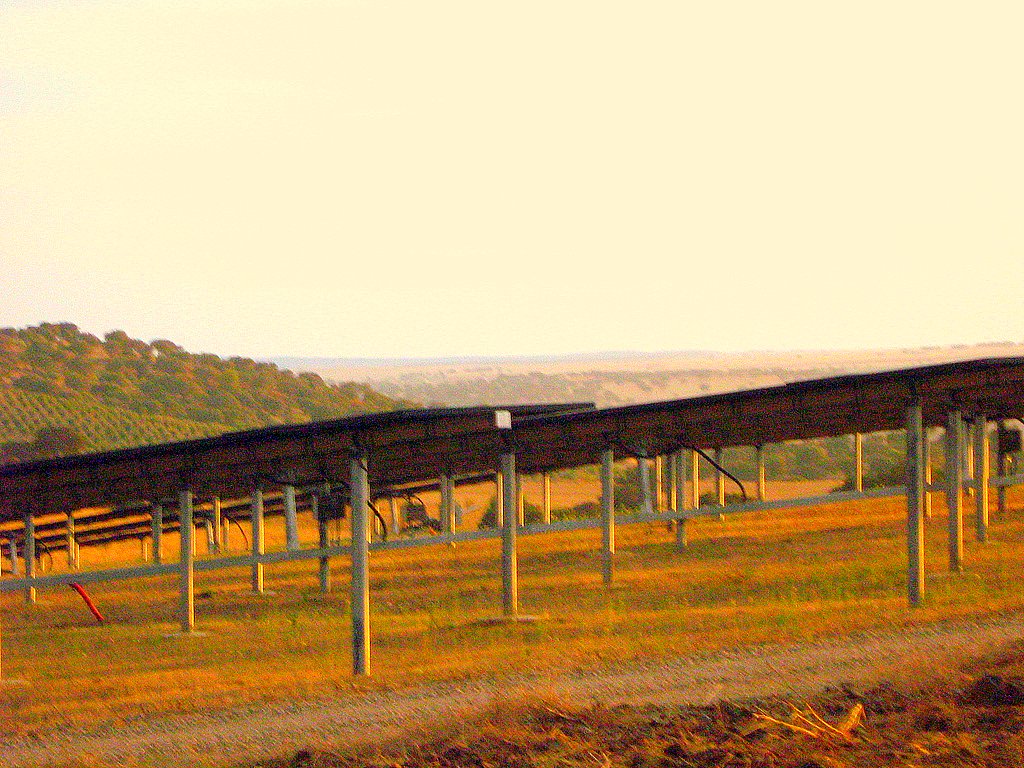
Photoset of Portugal´s largest photovoltaic power stations (until March), which are located in the Portuguese region of Alentejo.

Click the links below to read the five parts of the article “Alentejo: Solar Region”.


“Alentejo: Solar Region”

allvoices

Sunday, October 19, 2008

Serpa (Brinches) Photovoltaic Power Station [PICS]


Beginning of Autumn. At the end of a warm day - half an hour before the sunset and after having rolled across the spacious Alentejo’s plains - we finally get to the little village of Brinches. Next to a roundabout we find a rural road, which takes us through hills covered by vineyards and olive trees, typical of this soft landscape.

Read more


At one “corner” of the solar power station, we meet two men (a dog and some cows as well) who are contemplating the cloudy final of the day, uncommon this time of the year in one of the Iberian zones with the highest levels of solar radiation. In fact, these two men were the land owners, having rented their terrains to the GE Energy Financial Services, the project investor. What is very interesting in the Serpa project is the integration of clean power generation with the local agriculture.

They wonder about the huge quantity of energy daily injected in the electricity grid, as well as the fact the power plant being remotely controlled. The distance between the two PV power stations of Amareleja and Brinches is around 49 Km. During the construction there were many workers, but now the attentions are more focused on the “rival” Moura, the world's largest, after having dethroned Brinches this year.


Aerial view of Serpa solar power plant / renewableenergyworld.com

Brinches, Serpa, Portugal / Google Earth

Specifications of Serpa photovoltaic power station

Location: Portugal, Alentejo region, district of Beja, municipality of Serpa, parish of Brinches

Area occupied by power station: 60 ha

Installed rated power: 11 MWp

Annual electricity generation: > 18 GWh (equivalent to the consumption of
8,000 homes and farms in the region)

PV surface area: 34 ha

Number of PV panels: 52 000 (Sanyo, Sharp, SunPower and Suntech)

Solar tracking system: “PowerLight PowerTracker System”

Saving of more than 30,000 tons/year in greenhouse gas emissions compared to equivalent fossil fuel generation

Investment : 62 million euros

Conclusion: operational since January 2007

Project participants:
GE Energy Financial Services (Investor)
Power Light Corporation (Project and Construction)
Catavento, S.A. (Promoter and Asset Manager)


Photos by Luis Alves / www.flickr.com/photos/mokkikunta
(except the last two images)


This article is the part 5 of the article: “Alentejo: Solar Region”.

“Photovoltaic Solar in Portugal” - part 1 of the article: “Alentejo: Solar Region”
“Moura (Amareleja) Photovoltaic Power Station” - part 2 of the article: “Alentejo: Solar Region”
“Moura Renewable Energies Project“ - part 3 of the article: “Alentejo: Solar Region”The world’s largest photovoltaic power station [PICS] - part 4 of the article: “Alentejo: Solar Region”

allvoices

Monday, September 1, 2008

The world’s largest photovoltaic power station [PICS]


In Amareleja, a Portuguese parish of the municipality of Moura, the rural landscape was modified by hundreds of thin metallic structures anchored on the ground by concrete foundations. These structures support arrays of solar photovoltaic modules, which convert sunlight into electricity. Like big mirrors, these new elements emerge in the middle of some trees and typical houses of Alentejo region.


More...

The new solar photovoltaic power station will have the highest power so far installed in the world with this technology and comprehends more than 250 hectares of land, the vast majority without any agricultural or forestry aptitude. The impressive power plant will generate 90 million KWh a year, equivalent to the consumption of 30, 000 Portuguese homes. It has 2,520 solar trackers, 141 m2 each one, supporting 262,080 photovoltaic modules.

With an area of 108.34 km2 and about 2 700 inhabitants, the little village is famous for its maximum temperature records. The good wine, the good sheep's cheese and the black pork , make it good place to enjoy a good meal. Let’s hope they can successfully implement their local low-carbon economy.


Photos by Luis Alves / www.flickr.com/photos/mokkikunta


This article is the part 4 of the article: “Alentejo: Solar Region”.

“Photovoltaic Solar in Portugal” - part 1 of the article: “Alentejo: Solar Region”
“Moura (Amareleja) Photovoltaic Power Station” - part 2 of the article: “Alentejo: Solar Region”
“Moura Renewable Energies Project“ - part 3 of the article: “Alentejo: Solar Region”

allvoices

Thursday, July 24, 2008

Moura Renewable Energies Project


Alentejo is a region with low population density, occupying almost 33% of the area of Portugal and having only 5.2% of its inhabitants. As one of the European regions with greater population decrease, it will only be possible to reverse the economic decline through a population influx.

So far, Alentejo has no cities with sufficient dimension to achieve economies of scale, partly because of a weak urban system, which is blocking its development. However, Évora, with approximately 50,000 inhabitants, presents a very positive dynamic with some potential to reverse this negative trend.

Read more
For an effective regional development of Alentejo, it is critical to achieve the Alqueva Multi Purpose Project (Empreendimento de Fins Múltiplos do Alqueva) in its whole potential - agro-industry, agriculture, irrigation, tourism and renewable energies. This can be a great opportunity to develop the potential of Alentejo in the production of electricity from renewable sources, with emphasis on solar photovoltaics. The production will be carried out by centralized PV power plants, the Alqueva Hydroelectric Plant, small hydro plants, mini PV power plants and micro-generation.

The functional specialization, as a mechanism for creating competitive territories and stable employment, migth be a solution in the particular case of the Moura city and the surrounding territory, by the the promotion of a regional cluster in the area of solar PV and innovation.

Economic Viability - Commitments to development between 3 “actors” (central Government, Municipality and the private sector)

The economic viability of the project and the Government decision in terms of energy policy enabled a subsidised tariff, as well the following counterpart for the installation of the power plant:

- Construction of PV module assembly factory

- Establishment of a 3 M € Social Fund , contributed by Acciona and managed by a Commission formed by the CMM, DGEG and Acciona , that will be applied to the development of infrastructures to be owned by the municipality(CMM):

• Construction of a Laboratory of Renewable Energy

• Programme of dissemination and promotion of renewable energies

• Support for Research and Development

• Support for micro-generation

PV module assembly factory (MSF - Moura Fábrica Solar)

A €7.6 million PV panel manufacturing plant (MSF) will provide panels for the second stage of the Amareleja power station construction. The factory, located in Moura municipality (Amareleja parish, Baldio das Ferrarias), is being constructed by Acciona and became operational in December 2007. Its future production will be targeted at the international market, with a capacity of producing 24 MW of solar panels annually.

Economic Viability (because of the large size of the power plant)

Actually, the market for applications to be connected to the grid with significant centralized power installed (> 10 MW), is receiving particular attention from the investors.

Several economical reasons can be referred for this market trend:

- the high global demand has driven a significant increase in the Silicon price, causing an increase in the cost of PV panels and aggravating significantly the cost of the system (including installation) – the centralized facilities can be a solution to minimize these prices.

- centralized power plants allow large-scale orders, achieving significant reductions in the unitary cost of PV panels.

- central facilities allow potentially maximize the productivity of the electrical system by optimizing the exposure of the panels on the ground.

Some data:

Production: 24 MW / year (minimum annual p
roduction capacity)

Investment: 7.65 M €

Start of production: December 2007


Jobs: 115 direct jobs


Minimum Work Period: 10 years

Possibility of doubling the annual production.


Industrial unit of exporting capacity.

Anchor unit of the Technological Park to be installed.

A development strategy

A development strategy has the goal of creation of a cluster in the field of solar energy. To achieve this objective it will be necessary to implement the centralised PV power plant and the PV module assembly factory (previously described), as well the Moura Technological Park (Tecnopólo de Moura), that will be managed by the municipal company “Lógica – Sociedade Gestora do Parque Tecnológico de Moura, E.M.”

Moura Technological Park by Renewable Energy as a progress factor for the Community, Municipality of Moura, C3P & NASA Technical Workshop 2007

Moura Technological Park


( total area ~35 ha)

UP11 – detail plan
PV module assembly factory
Laboratory of Renewable Energy
Research and Development

Installation of new businesses
Sustainable construction: Headquarters Building and Park Housing
New sources of energy

Support for Micro-generation


- Financing and supporting the installation of photovoltaic panels and solar thermal panels in households.

- Encouraging the spread of mini- centrals in institutions. Currently, there are already 3 installations : Professional School of Moura, Secondary School de Moura and BI School of Amareleja.

Despite the PV market trend, small-scale applications, grid connected, have more sustainable future, especially those relating to integration into buildings. Here are some reasons for that:

- Building-Integrated Photovoltaics (BIPV) materials can play additional functions to the generation of electricity, which should be a critical factor to the solar PV competitiveness, in the absence of government incentives.

- generally, renewable energy sources have low energy density. That require an extensive use of land for the installation of a particular power. Given the current trend of significant increase of the penetration of renewable energies in the energy systems, it is expected fierce competition for land resource. In this sense, the PV energy is in a privileged situation, if the market would be targeted for available buildings areas and other urban structures.

Development of the City and the Region

Sustainable Energy and Buiding - Urban Network for Competitiveness and Innovation, by ECOS Project

Establishment of companies
Local generation of wealth
Economy requalification

Qualified employment creation
Installation of critical R & D capacity

International affirmation of the Moura city

Stimulation of specific segments of tourism
Relationship with other potentials (Alqueva, Termas, Heritage)

Respect and enhancement of high environmental value of the region
A municipality exporter of energy produced from renewable sources

References:

Renewable Energy as a progress factor for the Community, Municipality of Moura, C3P & NASA Technical Workshop 2007

Rodrigues, Maria João; Energia Solar Fotovoltaica, spes.pt - Energias Renováveis

PNPOT, Programa Nacional da Política de Ordenamento do Território,territorioportugal.pt

This article is the part 3 of the article: “Alentejo: Solar Region”

“Photovoltaic Solar in Portugal” - part 1 of the article: “Alentejo: Solar Region”
“Moura (Amareleja) Photovoltaic Power Station” - part 2 of the article: “Alentejo: Solar Region”

allvoices

Thursday, July 17, 2008

Moura (Amareleja) Photovoltaic Power Station

Aerial view of Amareleja by amareleja.com.sapo.pt

A 46 MWp (62 MWp in the 2nd phase) single-axis tracking system centralised photovoltaic (PV) plant in the Portuguese region of Alentejo (Moura municipality, Amareleja parish), promoted by the local municipality and Acciona Energia (Spain), is expected to be completed by the end of 2008.

The plant will have the highest power so far installed in the world with this technology. The installation of 46 MWp power represents an investment of approximately 250 million euros.

Read more

Until now there was installed 30.41 MWp - 66% of the total planned capacity. The installation work will continue through the summer and the plant - which already partially injects electricity to the grid with 3.18 MW operational from the end of 2007 - will likely become fully grid connected later this year.

The power plant will generate 90 million KWh a year, equivalent to the consumption of 30, 000 Portuguese homes. It has 2,520 Buskil solar trackers, 141 m2 each one, supporting 262,080 photovoltaic modules.

For the first phase of the solar plant that Acciona Energia is building in Moura, the company signed a contract with the Chinese company Yingli for the supply of PV panels. This agreement takes into account the extension of the supply for a second phase of the plant - 20 MW is planned to begin in 2009 and end in 2010.

Specifications of Moura Photovoltaic Power Station

Moura Photovoltaic Power Station by Renewable Energy as a progress factor for the Community, Municipality of Moura, C3P & NASA Technical Workshop 2007


Area occupied by power station: 130 ha (total area = 250 ha)

Installed rated power: 62 MWp (46 MW- 1st phase / 62 MW - 2st phase)

Annual electricity generation:
90 GWh (equivalent to the consumption of 30, 000 Portuguese homes)

Power transformers: 22

Inverters: 214

CO2 avoided: it will prevent the emission of 86,500 tons per year of CO2 from coal-fired power stations

Investment - ~ 250 million euros

Conclusion -1st phase: 2008; Conclusion -2st phase: 2010

A new land use - the sun as a resource

Aerial view of Amareleja, Google Earth

The total area in the parish of Amareleja, near the border with Spain, comprehends more than 250 hectares of land, the vast majority without any agricultural or forestry aptitude. The occupation of this space for the installation of a power plant represents the allocation of an economic function to a territory that was excluded from the local economy.

Some data:

2,200 KWh/m2
Sum of global annual irradiation, focusing on a photovoltaic module with optimal orientation for midday.

1,650 kWh / KWp
Sum of annual photovoltaic energy generated by 1 KWp with a performance of 0.75

Orography: adequate throughout the mainland and particularly in Alentejo region

Sun exposure: optimal angles - 33 to 34 degrees

Some engineering features

Amareleja power plant by amareleja.com.sapo.pt

The first phase of work will include Acciona’s single-axis Buskil trackers fitted with modules and also modules on fixed steel structures. The produced electricity will be transformed to 60 kV for evacuation to the grid at Alqueva. The project includes a control centre of the power plant, which will have an area for educational visits related to renewable energies.

Solar Trackers:

807 / 1713 = 2520 units (total 1st phase)
2520 solar trackers Buskil ( Acciona Solar technology) on 141 m2 (13 m length and 10.8 m high)

Reserved area of 848 m2 per structure

Oriented at the 45 ° fixed inclination and capable of 240 º East-West rotation movement following the sun across the sky.

Movements determined by coordinates previously entered

Modules:

104 polycrystalline silicon modules in each solar tracker (total = 262,080 PV modules)

48 cells (in serie) / each module;

Voltage: 23V at the point of maximum power / 29 V open circuit;

Electric current I: 7.4 A in the point of max. power / 8.1 A in short-circuit;

170 and 180 Wp capacity

Polycrystalline silicon modules, which consist of multicristaline silicon cells covered by an antireflective layer

Lifetime: more than 25 years

Project financing

In September 2006, the Spanish company Acciona, leader in the renewable energies sector, has acquired all the stocks of the owner of the installation rights (Amper-Central Solar SA) after a long process of consultation and negotiation with several companies and entities. Earlier, the Municipality of Moura had 88% of the capital, Renatura 10% and Comoiprel the remaining 2%. According to the President of the Municipal Chamber of Moura, it was essential to find a partner with the financial capacity to develop the project.

At the time, the municipality stated that the aim of the contract was the acquisition of the entire social capital of Amper, allowing the construction of the Central Solar of Moura with the initial installation (up to 2008) of 40 to 45 MWp and with the possibility of installation (until 2010) for more than 20 MWp. It also enabled the installation of a PV module assembly factory in Moura, as well a Fund of three million euros for the development of research projects related to renewable energies.

Indeed, single municipalities usually don't have sufficient financial capacity to realize big local projects like this one. To achieve this investment, the municipality had to sell its capital shares. As intermunicipal cooperation hasn’t worked in these cases, we may wonder whether the implementation of the administrative region of Alentejo might be a strong factor for maintaining environmental investments, partially or totally, in the hands of the region. The challenge will be to maximize the benefits (social-economical-environmental) of local populations, not the profits of global corporations .

In the next article we will describe the Moura Project on other main “tracks”: Moura Solar Factory (MFS), Moura Technological Park and the Micro-generation program - in the context of the Regional Development strategy.

References:


Notas de prensa, www.acciona-energia.com

Publicações do MEI - Livros de Energia, Ministério da Economia e da Inovação


This article is the part 2 of the article: “Alentejo: Solar Region” “Photovoltaic Solar in Portugal” - part 1 of the article: “Alentejo: Solar Region”

Published on www.newropeans-magazine.org

allvoices

Thursday, July 10, 2008

Photovoltaic Solar in Portugal

Spain & Portugal - global irradiation & PV potential for optimum angle
Šúri M., Huld T.A., Dunlop E.D. Ossenbrink H.A., 2007. Potential of solar electricity generation in the European Union member states and candidate countries. Solar Energy, 81, 1295–1305, re.jrc.ec.europa.eu/pvgis

Portugal is one of the European countries with the highest levels of solar radiation (particularly the Alentejo region), enjoying excellent conditions for photovoltaic conversion with generating indices of about 1500 kWh/year for each installed kWp (in optimal conditions). For example, in terms of average annual number of hours of sun Portugal varies between 2,200 and 3,000 h, while Germany varies between 1,200 and 1,700 h.

Read more
Until 2007 there were predominantly local isolated autonomous systems (<20 kWp). Afterwards, new solar power projects for centralised systems emerged, adding more than 14 MW to the installed capacity in 2006 (3,4 MW) - an increase of more than five times. Among these systems, the following started operation in 2007:

- 11 MWp single-axis tracking power plant in east Alentejo (Serpa municipality)
- 2,15 MWp two-axis tracking power plant in south Alentejo (Almodovar municipality)
- 756 kWp a-Si plant in Mertola (south of Portugal, Alentejo region)

Cumulative PV Power Capacity Installed in Portugal (1995-2007)

Image: IEA-PVPS - Portugal country report 2007

As we can note, the Portuguese PV market increased strongly in 2007, from a cumulative power of 3,4 MWp to 17,8 MWp, due to the completion of the mentioned power plants.

A 46,4 MWp (62 MWp) single-axis tracking system centralised PV plant in east Alentejo (Moura municipality), promoted by the local Municipality and Acciona Energia (Spain), is expected to be completed by the end of 2008.

There is also a great potential for integrated systems in buildings (BIPV). This can lead to a creation of a sustained market - the installation of 1.5 kWp systems in new buildings could result in an annual potential of 60 MWp.

Cluster of Photovoltaic

Open Renewables, Lobo Group: produced high quality photovoltaic modules on an exclusive basis for Siemens Solar, from 1994 to 2001 and for Shell Solar, from 2001 to 2006. It is an independent producer since 2007, currently with an installed capacity of 45 Mwp and about 950,000 units produced since 1994. It exports 99% of production to 19 countries in Europe, North America, Africa and Asia.

Solar Plus: manufacturers of photovoltaic modules in amorphous silicon, 2nd generation. They initiated a pilot phase of production in late 2007 with initial capacity of 5.5 MW expandable to 11 MW.

Investhome, DST Group: manufacturers of photovoltaic modules in crystalline silicon.

Martifer Solar: manufacturers of photovoltaic modules in crystalline silicon. They began the construction of a production unit that will be ready by the end of 2008 with a capacity of 50 MW per year. This production unit will have the capacity to double the production in a short space of time and will be fully automated.

WAS Energy: manufacturers of optical equipment and tracking for photovoltaic systems based on their own patents. The WAS Energy has a production line at the Taguspark.

A module assembly factory will be installed in the Moura Project, which will be described with more details in the next article of this series, focusing on photovoltaic solar.

There is also an industry of power electronics and good installers in the market. It was created a Technical committee of Photovoltaic standardization (CTE 82) for monitoring the European and international standards.

Fundamental research activities are carried out in a dozen public institutes and university R&D units mainly in the area of thin film technologies, crystalline silicon ribbon and organic cells.

EU Objectives

Europe - global irradiation & PV potential for optimum angle
Šúri M., Huld T.A., Dunlop E.D. Ossenbrink H.A., 2007. Potential of solar electricity generation in the European Union member states and candidate countries. Solar Energy, 81, 1295–1305, re.jrc.ec.europa.eu/pvgis

The EU objective is to achieve, by 2015, the competitiveness of PV with the cost of electricity to consumers of 0.15 € / kWh (or a cost of the system of 2.5 € / Wp).

To obtain these goals it is necessary to create new materials and manufacturing processes, reducing the cost; improve the performance of BOS (balance of system) components; acting in the field of Standards and Quality and in the social area.

Some benefits include the creation of jobs associated with market promotion and evolution of PV. The investment in the area of photovoltaic systems can create companies of manufacturing, engineering, installation and maintenance and employment with a particular focus at the local level.

Manufacturing: 7 jobs per MW produced.
Engineering and Installation: 30 jobs per MW installed.
Maintenance: 2 jobs per MW installed.

Portugal objectives: 2007-2010

In 2001, Portugal assumed a goal in the promotion of renewable energies. Within the framework of the European Parliament and the European Council Directive 2001/77/CE, the country undertook to increase renewable energies' contribution to 39% of annual gross electricity consumption by 2010.

In order to reduce energy imports by substitution with local renewable sources, fight climate change and reduce greenhouse effect gases emissions (GEE), the actual Government reviewed the goals defined in Cabinet Resolution 63/2003: increase the goal set for 2010 for power generation based on renewable energies from 39% to 45% of total electricity consumption.

With respect of PV and to ensure the goals:

Solar energy: construction of the world's largest photovoltaic plant (the Moura plant) and ensure link to micro-generation policies. The Moura Photovoltaic Power Station represents about 30% of the objectives of photovoltaics in Portugal (national target of 150 MW).

Micro-generation: program for installing 50,000 systems until 2010, with incentives to the installation of water heating systems based on solar energy in existing houses. This program could create new business opportunities for installers, industry and energy service companies, stimulating the market of renewables. The micro-generation program is mainly oriented to electricity consumers. The special regime applies exclusively to renewable sources (solar PV, wind, hydro, biomass and fuel cells) with the maximum of interconnection power by application limited to 3,68 kW (solar PV national target of 22 MW).

References:

IEA-PVPS, Portugal country report 2007 - PV technology status and prospects, iea-pvps.org

Publicações do MEI - Livros de Energia, min-economia.pt

This article is the part 1 of the article: “Alentejo: Solar Region”

Published on www.newropeans-magazine.org

allvoices