Covers environment, transportation, urban and regional planning, economic and social issues with a focus on Finland and Portugal.
Showing posts with label economia. Show all posts

Wednesday, April 6, 2011

Portugal Requests EU Bailout‎: the Wrong signal at the Wrong time


Communication of Portugal PM, José Socrates - [Jornal Publico]

"As always said to Portuguese, the rejection of the Stability and Growth Pact in the Parliament, on March 23, dramatically worsened the financial situation of our country. The rejection of the Government proposed  "PEC", which had the support and vote of confidence from European institutions, was the  more wrong signal  that we could give to the financial markets and international institutions. It was the wrong signal at the wrong time."

allvoices

Wednesday, March 23, 2011

Portugal PM Socrates Resigns After Parliament Rejects Austerity Plan [VIDEO]


Portugal political crisis over  sovereign debt - Prime Minister José Sócrates tendered his resignation after Parliament rejected a new government austerity plan (PEC IV), moves expected to greatly increase pressure on the country to accept an international bailout.
In Ireland a bail-out by the euro zone’s rescue fund helped to force the government into calling (and losing) an early election. In Portugal an early election may force the government into accepting a bail-out. The question is: which government?

allvoices

Portugal and Finland could overshadow EU summit


FT.com / Brussels - #Brussels fears #Lisbon left rudderless http://t.co/d2XMLlMWed Mar 23
‎Even if Portugal were to ride out the storm with its government in limbo, European officials worry that failure to pass the EU-backed measures on Wednesday and Mr Sócrates’ resignation could overshadow the upcoming summit.
“If there is a fall of the Portuguese government, we’re in trouble,” said one senior European diplomat involved in economic negotiations. “How do you sell this as a credible collective response?”

"Finland Holds Key to #Euro Zone ‘Grand Bargain’ - CNBC-http://www.cnbc.com/id/42206590Wed Mar 23
When European Union leaders gather in Brussels at the end of the week to finalise a much-anticipated “grand bargain” to solve their debt crisis, the eyes of the financial markets will be focused on an unlikely place: Finland.
After months of negotiations, the Finnish government, normally one of the most pro-European Union members in the bloc, is set to hold up one of the central elements of the package, in part because it has been blindsided at home by the rise of a populist anti-euro party that is threatening to cause havoc in next month’s national elections.(...)
Without unanimity in the euro zone, the deal could fall apart. In an interview with the Financial Times, Ms Kiviniemi acknowledged that Finland was playing the unusual role of “troublemaker” in negotiations.
But, with the parliament’s Europe committee opposing the increase and the legislature dissolved ahead of the April 17 elections, her hands are tied. 
“I don’t have the mandate from the parliament to increase them,” she said, noting it would have to be called back into an emergency session to approve an increase.
“It would be very, very difficult. I would say impossible, because this topic is a very hot one.” Ms Kiviniemi is not the only one struggling with the issue. 
UPDATE
Portugal Premier Quits After Austerity Plan Is Rejected

allvoices

Friday, January 14, 2011

No, Paul Krugman, Portugal Is Not Broke


No, Paul #Krugman, #Portugal Is Not Broke: the Game is Over. http://goo.gl/SHXDE #euroThu Jan 13 

allvoices

Sunday, January 2, 2011

Os Mercados ou a Humanidade?


2011 será um ano decisivo e dramático para o povo português. Numa altura em que o país é diariamente "intoxicado" com propaganda neoliberal proveniente dos economistas que contribuíram para o gravíssimo problema económico-financeiro que Portugal atravessa - sendo o actual alvo dos mercados especulativos da dívida pública - é fundamental ler estas duas entrevistas do sociólogo Boaventura de Sousa Santos, das quais destacamos algumas ideias essenciais:
  • As crises, de 2008 e 2009, que se pensava que poderiam ser superadas em 2010, não o foram. Pelo contrário, estão em constante agravamento e, provavelmente, vão ser muito mais graves para os portugueses a partir de Março.
  • Portugal passou a ser um alvo de ataques especulativos que não se justificavam em termos estritamente económicos.
  • O euro foi o grande negócio da Alemanha.
  • Os nossos comentadores dizem mal do Estado, das políticas sociais, mas depois dizem umas frases suaves sobre os mercados financeiros.
  • Portugal está em crise financeira por contágio. Porque é um elo fraco, porque é uma economia fraca, com problemas estruturais, mas não é a Portugal que os capitais financeiros querem atingir. Querem atingir Espanha e Itália. Só que não podem lá chegar sem ir por Portugal, pela Grécia e pela Irlanda.
  • Os mercados são um bando de criminosos, que andam por aí muito bem vestidos, mas são uns mafiosos. Não há dúvida que se trata de um crime contra a humanidade, porque estão a lançar para a fome populações inteiras, para que uns poucos enriqueçam de uma maneira escandalosa. 
  • Estive em Nova Iorque e na 5.a Avenida bateram-se os recordes de venda dos produtos mais caros. Voltaram a abrir as carteiras, têm dinheiro como nunca em Wall Street, aqueles que produziram a crise.
  • Nunca imaginei que o neoliberalismo tivesse canibalizado tanto os estados. O neoliberalismo nacionalizou os estados, os bancos nacionalizaram os estados, não foram os estados que nacionalizaram os bancos. 
  • Passou a ideia de que um banco não pode falir. As empresas podem falir, um banco não pode falir. 
  • Os abutres dos mercados financeiros estão a destruir a riqueza do mundo para se enriquecerem escandalosamente sem nenhum controlo e há-de haver um momento em que o povo, os governos, vão dizer basta. E os portugueses, quando começarem a sentir no bolso e na cabeça, e não só no bolso, estas medidas que vão começar a ser aplicadas.
  • O Presidente da República Cavaco Silva tem dito que não se deve achincalhar os mercados porque eles podem reagir contra nós...Penso que o senhor Presidente da República está equivocado. Não há outra solução para a Europa que não seja a regulação financeira. Os mercados vão destruir o bem-estar das populações, criar um empobrecimento geral do mundo, para o enriquecimento de poucos. É necessária uma regulação forte.
  • O FMI vai entrar em Portugal? Não tenho nenhuma confiança de que os que estão nesse grande mercado lucrativo dos títulos de dívida soberana não estejam com os olhos em Portugal. Para chegar a Espanha, obviamente. Como é que fazem isso? Com outra coisa escandalosa, que são as agências de notação.
  • Vai haver obviamente mais contestação na Europa. É dessa contestação que vai surgir o golpe de asa de que precisamos e vamos tê-lo por pressão popular.
  • Incrivelmente, há aí muitos tontos, economistas trauliteiros, que tenho hoje muita dificuldade em respeitar, que até parece que desejam o FMI. Mas desejam--no porque têm boas reformas, bons empregos, foram ministros ou estão em grandes empresas, são aqueles que não serão nada atingidos por essas medidas.
  • O WikiLeaks foi o acontecimento internacional do ano. Agora sabemos o que foi feito no Iraque. Os dados que têm saído do WikiLeaks são aterradores, acerca da brutalidade da guerra e das atrocidades que se cometeram, da falsidade dos discursos que se fizeram. Percebemos como é despótico o poder, como é falso e hipócrita. O mundo está feito de falsidade e o WikiLeaks foi uma grande desilusão para quem acreditava que a diplomacia era uma coisa muito nobre
  • Estamos a passar de um período em que os activistas eram todos aqueles que estavam normalmente de fora - os revolucionários, os anarquistas, os sindicalistas não tinham nada a ver com o sistema - para um período em que as transformações, as alterações têm partido de dentro do sistema. Vêm de quem tem acesso ao conhecimento. 
Boaventura de Sousa Santos será o primeiro português e cientista social a receber o Prémio México de Ciência e Tecnologia. Será o Presidente mexicano que, dia 14, lhe entregará o galardão pelo trabalho no espaço ibero-americano.  Esperemos que os media corporativos portugueses lhe dêem também o destaque que merece...

Ler na íntegra as duas entrevistas através dos seguintes links:

"Os mercados cometem crimes contra a humanidade"  www.ionline.pt

"Com estas medidas de austeridade Portugal não vai pagar a dívida"  dn.sapo.pt

allvoices

Tuesday, November 9, 2010

Portugal Near Default: Bond Yields Reach New 7% Record


A month ago, the portuguese Finance Minister  Teixeira dos Santos said that if the interest payments surpass the threshold of 7% , Portugal would have to start thinking of resorting to international aid.

Today, the  "yield" of Portuguese 10-year bond down slightly since the late morning, after hitting new highs (7 %) since Portugal adopted the euro currency.

While Ireland doesn't plan to enter primary markets the rest of this year, Portugal will auction as much as €1.25 billion bonds Wednesday. It is likely to pay record yields of nearly 7% on its 10-year bond, a level deemed unsustainable over the long term.

For Silva Lopes,  former Finance Minister  of Nobre da Costa Government,  assistance from the European Fund and the IMF would have two advantages. First, would reduce interest payments and, secondly, would bring the fiscal adjustment measures, that "governments have not been able to do." 

allvoices

Friday, April 16, 2010

Debt Crisis Watch - Next target: Portugal?

PIMCO – Bill Gross | February 2010: The Ring of Fire


"Debt Crisis Watch Turns to Portugal - Next target: Portugal", an article today published in The New York Times, puts Portugal featured on Google. The text is a description of the terrible portuguese economic and financial situation.


Accordingly, analysts say, it will be all the more difficult for Portuguese politicians to explain to their already pinched populace that more sacrifices — from public-sector wage cuts to higher value-added taxes — are necessary.(...)
Gilles Moëc, an economist for Europe at Deutsche Bank, said, “It is going to be a long and painful process for Portugal, and there are questions about whether they can do it.” He added, “It’s a reminder that there is an issue here.”, The New York Times.

allvoices

Thursday, March 4, 2010

Keynes e Krugman num Plano Inclinado


No programa da SIC-Notícias Plano Inclinado, Mário Crespo, João Duque e Henrique Medina Carreira debateram com Rui Moreira a política de Estado para as empresas. 

De registar que, durante este interessante debate, não se ouviu pronunciar  a palavra "descentralização" ou  "regionalização", elementos decisivos para potenciar os factores de competitividade das economias,  para além do indicador de crescimento do PIB.

allvoices

Thursday, February 4, 2010

Is Portugal a risk to the Eurozone?

"There is a very real threat of contagion spreading to other countries in the eurozone, like Spain and Portugal, which are suffering similar difficulties with the size of their budget deficits" http://goo.gl/TtRe

  • Banca asfixiada tira 5% do ar da bolsa | agência financeira http://goo.gl/cGui #crash #Lisbon #Economy 
  • Juncker: «#Portugal não é um risco para a Zona #Euro» | agência financeira http://goo.gl/NmZi #Econ
  • Acha que o Governo vai cair? «Governo andou a criar uma crise artificial» > > TVI24 http://goo.gl/sRGw #Portugal
  • As maiores quedas de sempre do #PSI 20 http://economico.sapo.pt/noticias/as-maiores-quedas-de-sempre-do-psi-20_80733.html #Portugal
  • Finanças Regionais: Aprovada por maioria proposta para limitar endividamento a 50 milhões de euros http://ow.ly/16uXNr
  • Finanças Regionais: oposição aprova limite de endividamento - PS fica isolado a votar contra a iniciativa proposta ...http://ow.ly/16uY8W
  • Banca asfixiada tira 5% do ar da bolsahttp://goo.gl/fb/gXZ3
  • Trichet evita falar de Portugal e Espanha e diz que Grécia deve avançar com reformas (www.lusa.pt)
  • Potencias en rojo : De la "crisis financiera" a la "crisis de los Estados": http://bit.ly/93wowz
  • El #FMI recomendó a España, Grecia y Portugal que rebajen los salarios: http://bit.ly/dyOS0y #econ
  • Movimento emigratório actual comparado ao da década de 60 - Sociedade - PUBLICO.PT http://bit.ly/dxltfu #Portugal
  • #Portugal será o país mais prejudicado por corte salarialhttp://ow.ly/1o15mB #FMI
  • FT.com / Brussels / Economy - #EU tells #Greece to cut public sector wages http://goo.gl/Aum5
  • FT.com / Medicine for #Europe 's sinking southhttp://goo.gl/z2yo #econ #crisis
  • http://bit.ly/bbAPRP #crisis Bruxelles place la Grèce dans un état de quasi-tutelle budgétaire/ cela promet de sacrées révoltes !
  • http://bit.ly/dmzw03 #crisis "25 départements français sont au bord de la faillite", De nombreuses communes allemandes menacées de faillite
  • Is Portugal the new Greece? | Money Supply | FT.comhttp://goo.gl/VHCNcom - #Portugal
  • Bond Auction Disappointshttp://on.wsj.com/95f6Pr #economy #EU
  • WSJ.com - #Greece Shouldn't Count on Euro-Zone Bond http://on.wsj.com/9T3A09 #economy #EU
  • #Portugal salta para as manchetes da imprensa internacional | Económico http://goo.gl/glTT #ECONOMY
  • #Portugal e #Espanha lideram perdas nas bolsas mundiais | Económico http://goo.gl/iZiF #economy
  • Portuguese Bonds Drop as Borrowing Costs Soar at Bill Auction http://www.bloomberg.com/apps/news?pid=20601085&sid=achpanjSq3AI #Portugal
  • #EU Backs Greek Deficit Plan; Papandreou Offers Cutshttp://www.bloomberg.com/apps/news?pid=20601085&sid=atECkQgRuUgM #econ
  • #Almunia diz que #Portugal e #Grécia partilham problemas | agência financeira http://goo.gl/TXnk #econ
  • Risco de Portugal dispara nos mercados (act)http://xl.pt/r/9pcm62
  • Risco da dívida portuguesa é o que mais sobe no mundo | Económico http://goo.gl/5HxV #Portugal
  • Mercado da decadência "Estes são os tempos em que os decadentes ocupam os lugares vagos, são usados para entreter."http://bit.ly/bAK3Ps
  • #portugal Portugal vende dívida com juro mais elevado num ano - DiarioEconomico.com: http://bit.ly/a4AlkE 
  •  Economic news headlines: EC: a toothless regent in Greece? - Money Supply ECB urges Irish veto on central bank mer...http://bit.ly/aiSzLO

allvoices

Tuesday, May 26, 2009

A record number of new student housing in Helsinki, Finland

A significant change in the structure of the city of Helsinki (Finland) is currently in progress.According to the Master Plan 2002 Helsinki will be developed as an European capital city.Helsinki is an important part of a growing metropolitan area. The urban structure is moderately becoming more integrated and dense, but without damaging the basic city characteristics or compromising its spaciousness and natural features.
Read more
Länsisatama - West Harbour: downtown by the sea, Landscape architecture competition - Press photos--City of Helsinki/City Planning Dep.

The Länsisatama (West Harbour) redevelopment project of the Helsinki City Planning Department is comprised of more than 200 ha of land on the southwest waterfront of the Finnish city. Like other planning projects in the area, this one has generated a lot of public interest. Indeed, the construction of a big new urban district from scratch is rare and raises the question: what is the city of the future? [1]

The areas covered by Länsisatama project include:
  • the residential and office area of Ruoholahti (built in the 1990s)
  • Jätkäsaari (used previously for cargo and passenger traffic)
  • Munkkisaari (used as a dockyard, part of which will be freed for other uses in 2012)
In 2007, a local plan for a comprehensive solution to the Jätkäsaari area was in preparation. This year, during the next spring, the first detailed plan with the largest permitted building volume in Jätkäsaari will be handled in the Helsinki City Council. Jätkäsaari will house 15,000 residents and provide 6,000 jobs. The area was freed for construction when the cargo port was transferred to the new harbour in Vuosaari, at the end of 2008.

Planning image of Vuosaari harbour--City of Helsinki/City Planning Dep.

Within the next two decades, the Länsisatama area will have been transformed into a waterfront city quarter with an estimated population of 22,000, which will enhance the appeal of central Helsinki and its services as a whole. [2]


Jätkäsaari (2007 data)

Size: 100 ha
Parks: 19.8 ha (13 m2 per capita)
Residents: 14,500
Jobs: 6,000
Housing: 600,000 m2 gross floor area
Jobs and services: 364,000 m2 gross floor area
Parking spaces: 1 space per 150 m2 gross floor area
City investment: EUR 217 million
Construction start: 2008
Completion date: 2023


The Jätkäsaari planning goals


Länsisatama - West Harbour: downtown by the sea, Landscape architecture competition - Press photos--City of Helsinki/City Planning Dep.
  • Produce whole new attractive and ecologically sustainable city district, not just a sleepy suburb
  • Meet the everyday needs of residents and workers
  • Social well-being
- Differing socio-economic groups live close to one another all over the city (town planning aims to encourage this assimilation).

- Construction of the new district is expected to help meet the need for all types of housing, thus easing the housing situation throughout Helsinki:

About one third of all the housing will be social housing i.e. moderately priced rental flats owned by the City and other non-profit landlords;

Another third will be price-regulated free-market housing and right-of-occupancy housing;

The remaining third will be privately funded housing.
  • To take advantage of special features of the area (district is almost entirely surrounded by the sea and shipping)
- The passenger harbour on the east side of the area will remain in its present position, catering for some 3 million passengers per year travelling from Helsinki to Tallinn and St Petersburg and vice versa.

- The buildings have been designed so that the streets do not turn into wind tunnels.

- No residential buildings will be placed in the immediate vicinity of the passenger harbour, because of the noise, bustle and pollution caused by shipping.

- A beach will be created on a sheltered cove in the area.
  • Mobility management - New Mobility Culture: non-dependence of private cars in daily traffic
- Available good alternative modes of transport : trams, service bus lines, car share vehicles, taxis, bikes.

- Cycle paths to serve those living and working in every part of the district.

- High quality pedestrian environment.

- Up to three tram lines.

- Helsinki Metro already runs close to the northern edge of the area.

- Very few streets allowing vehicular access.

- Every residential street will be a cul-de-sac.

- Minimizing motorized traffic will also apply to waste management (garbage removal underground): sorted household waste will go straight into a pneumatic conveyance system leading to a central underground collection point.

- Car-free lifestyle: return to the traditional practice of having ground-floor shops in a continuous line along the streets.

- Municipal services be located within walking distance of users' homes.

"We are putting up a whole new city district, not just a suburb. Our starting points are that life there must be ecologically sound and pleasant, and it must meet the everyday needs of residents and those who work there. Social well-being, mobility management and the special features of the area are also important factors,"

"We are realistic enough to know that many Jätkäsaari residents will want their own wheels, but our idea is that local services and routes will be planned so that a car will not be needed for local access. Multi-storey car parks are planned for residents to keep parked cars from clogging up the streets", said, in 2007, the Project Leader Matti Kaijansinkko, the architect in charge of planning Jätkäsaari. [2]


Architecture

Länsisatama - West Harbour: downtown by the sea, Landscape architecture competition - Press photos--City of Helsinki/City Planning Dep.

Another feature that Kaijansinkko was proud of is the green belt winding through the area, reminiscent of Manhattan's Central Park. The green belt is expected to achieve great popularity and importance for the life of the whole district.

"The park has been designed to accommodate as many popular Finnish outdoor pursuits as possible: it will be possible to ski and skate there, to cycle, to play games and to enjoy a picnic. There will also be a sledging hill for children." [1]

Urban Development

InfoCentre Korona, the main building of Viikki green university campus district--City of Helsinki/City Planning Dep.

Urban housing challenges in Finland are relatively new. However, rapid development in recent years have spurred the movement of people into growth centres and increased the demand for housing.

Outside growth centres, part of the housing stock is vacant as the population is declining. A current issue is how to maintain a unified community structure, especially in cities such as Helsinki where high house prices make it difficult to attract people working in the service sectors.
Therefore, in the next decades urban investments are needed in the following areas:
  • Regenerating urban harbour areas in Helsinki
  • Transport infrastructure in the metropolitan region
  • Housing development
  • Housing repairs

A record number of new student housing in Helsinki metropolitan area


Eco-Viikki is a housing area but also a noteworthy and internationally renowned experimental project--City of Helsinki/City Planning Dep.

Second YLE, the official site of Finland's national broadcasting company, in three years the Metropolitan area will rise to a record number of new student housing.

HOAS (Foundation for Student Housing in the Helsinki Region), responsible for the construction, plans to build a total of almost 900 new homes. In total, HOAS rents out 8,200 apartments to 17,000 tenants. The average annual construction volume will almost double. The normal annual rate has been 150-200 new homes. New estate will rise, mainly in Helsinki and Espoo.

HOAS was established by 16 student unions and student bodies in 1969 to help relieve the shortage of student housing within the Helsinki metropolitan area. HOAS student accommodation can be applied for by anyone undertaking full-time studies in a secondary level educational institution or university, and part of HOAS’s accommodation is reserved for international exchange students and researchers.

According to Heikki Valkjärvi, CEO of HOAS, the current economic climate is favourable to these plans: “Construction costs have come down, so we are trying to launch as many projects as possible”, Valkjärvi recently said to YLE.

The next few years, the major projects will rise in Viikki, Jätkäsaari, Kalasatama and Matinkylä Matinkylä district of Espoo. In addition, HOAS will also accelerate housing renovations.The Viikki project will launch a construction boom, which is larger than any other HOAS project has been for many years. ”Because of the new Aalto University, the focus on construction is likely to be in the west in the future”, Valkjärvi told to HS.

Kalasatama will be planned for 18 000 residents and 10 000 jobs--City of Helsinki/City Planning Dep.

The chronic shortage of student housing continues in Helsinki, and the queues for housing at the HOAS have been increasing year after year. With the gradual increase in rents, most students are unable to compete in the unregulated rentals market in the Greater Helsinki. In comparison, the Foundation charges EUR 220 for a small 18 m2 room with the basic amenities in a former old people’s home in Helsinki’s Ruskeasuo district, while a bedsitter on the open market would easily cost EUR 600 to 700.

The number of applicants doubled over three years - in August 2005, it was 3,300, while in the autumn of 2008, the figure was 6,200, setting a record in the 30-year history of HOAS.


References:
[1] Salla Korpela, Jätkäsaari – city life for the new millennium?, virtual.finland.fi, Ulkoasiainministeriö, September 2007

[2] City of Helsinki/City Planning Department, Länsisatama - West Harbour: downtown by the sea, www.hel.fi , 15.08.2008


Related articles:

City of the future is for people, not cars 11.10.2007

allvoices

Monday, January 12, 2009

Sweden Ranks First in Sustainable Society Index 2008

The Sustainable Society Foundation has published its update of the 2006 Sustainable Society Index, which covers 151 countries. The new publication, the SSI-2008 , has been launched December 2008 and integrates for the first time sustainability and quality of life in an understandable way. The SSI is based on public data from scientific research institutes and international organizations.

The world average score is a mere 5.7 on a scale of 0 to 10. The Nordic Region is on the top for sustainable development: Sweden scored 7.02, followed by Switzerland, Norway, Finland, Austria and Iceland. Portugal (6.16) was 25th on the list of 151 countries.

Read more

Top 15 - Sustainable Society Index 2008

1 SWEDEN
2 SWITZERLAND
3 NORWAY
4 FINLAND
5 AUSTRIA
6 ICELAND
7 VIETNAM
8 GEORGIA
9 NEW ZEALAND
10 LATVIA
11 COSTA RICA
12 LITHUANIA
13 NETHERLANDS
14 DENMARK
15 GUYANA
(...)
25 PORTUGAL

Sustainable development is a concept very much discussed and considered important for most of the people. However, it is very difficult to measure in our society. Many indexes have been developed, but until recently there was no index, which comprises all the aspects of a sustainable society, which is simple, clear and transparent and which is adequate for comparison between countries.

The SSI has been built on the solid definition of the Brundtland Commission, with the addition of the third important aspect of freedom:

A sustainable society is a society:
• that meets the needs of the present generation,
• that does not compromise the ability of future generations to meet their own needs,
• in which each individual has the opportunity to develop himself in freedom, within a well-balanced society and in harmony with its surroundings
(this third aspect is very important to get a clear view of the quality of life in a country, because "without quality of life sustainability makes no sense and quality of life without sustainability has no future").

The framework of the ISS consists of 5 categories (each one with several indicators- the lowest scores are for Consumption of Renewable Energy (3.2) and Waste Recycling (1.7). The highest score is for International Cooperation (9.2))::

I Personal Development
1. Healthy Life
2. Sufficient Food
3. Sufficient to Drink
4. Safe Sanitation
5. Education Opportunities
6. Gender Equality

II Healthy Environment
7. Air Quality
8. Surface Water Quality
9. Land Quality

III Well-balanced Society
10. Good Governance
11. Employment
12. Population Growth
13. Income Distribution
14. Public Debt

IV Sustainable Use of Resources
15. Waste Recycling
16. Use of Renewable Water Resources
17. Consumption of Renewable Energy

V Sustainable World
18. Forest Area
19. Preservation of Biodiversity
20. Emission of Greenhouse Gases
21. Ecological Footprint
22. International Cooperation

Second the report, in the past two years the world made a relatively little progress towards a sustainability society.

Positive aspects:

- The scores of all 6 indicators of the category Personal Development have modestly increased (the largest contribution to this progress comes from Employment and Public Debt, due to a worldwide economy growth during the analyzed period).

Negative aspects:

- Deterioration of decisive importance issues - regardless of all plans and targets, the increase in renewable energy production does not keep in step with the rapidly growing energy consumption and the emission of greenhouse gases has, also very contrary to all targets set, further increased.

Priorities:

On a global scale the direction of the declining indicators should be reversed urgently to avoid further deterioration - Emission of Greenhouse Gases, Consumption of Renewable Energy, Ecological Footprint and Income Distribution.

In many countries, the inequality in Income Distribution is still growing and may become a threat for a well-balanced society. Waste Recycling, the indicator with the lowest score needs special attention, but all indicators need attention at specific regional level.


The full publication, with the data of all 151 countries, can be downloaded for free from the website - www.sustainablesocietyindex.com


IMAGE: Scheme of sustainable development: at the confluence of three constituent parts, by Johann Dréo, en.wikipedia.org, Creative Commons "Attribution ShareAlike 2.0 France"

allvoices

Thursday, December 18, 2008

Photovoltaics Status Report 2008: 60% increase in solar panel production

On December 11, the European Commission's Joint Research Centre has released the latest Photovoltaics Status Report. According to JRC, this scientific study combines analysis of up-to-date international manufacturing and market implementation data throughout 2007 with subsequent strategic and political developments up to September 2008.

Read more


Preliminary findings demonstrate the next key facts:
  • an increase in the yearly growth rate of solar photovoltaic production, averaging 40% over five years and then peaking at 60% in 2007;
  • a €5.7 billion turnover in Germany in 2007 with in excess of 100,000 houses installing solar panels;
  • world electricity production with PV systems is ca 10 Billion KWh, of which half comes from the EU. Solar energy still accounts for only 0.2% of total electricity consumption in Europe. Yet, the net effect is 4 million fewer tonnes of CO2 being released;
  • incentive schemes and technical advances are having a positive downward impact on photovoltaic costs. Market value is estimated to reach €40 billion by 2010 with lower prices for consumers.

Joint Research Centre predicts that more than 15TWh of electricity will be generated in 2010, what is equivalent to 0.5% of the EU 27 total net production of electricity in 2006 (the same as Slovenia's total electricity consumption). This prediction is sustained on photovoltaic growth scenario for Europe based on 2001 to 2007 data, an analysis of European policies and assessment of current investments.

Other projections are that by 2012 China will account for 27% of worldwide solar cell production capacity (approximately 42.8 GW), followed by Europe with 23%, Japan with 17% and Taiwan with 14%.

Photovoltaic (PV) solar energy is one of 14 different energy technologies that the European Commission's Joint Research Centre is currently assessing within the context of the SETIS (Strategic Energy Technology Information System), which is a key input to Europe's current energy policy. The Joint Research Centre, through the SETIS provides independent, validated and reliable information on energy technologies.This ranges from research on hydrogen fuel-cells and solar to nuclear energy.

The JRC comprises 2,750 staff across seven research institutes in 5 EU Member States (Belgium, Germany, Italy, The Netherlands, Spain), including the Institute for Energy in Petten, North Holland.


Second JRC, the last edition of the Photovoltaic Status Report 2007 was downloaded 150,000 times.

You can get a free copy of the new Photovoltaic Status Report 2008 at:
re.jrc.ec.europa.eu/refsys/ [PDF]

_________________________________________________

PV Status Report 2008
Research, Solar Cell Production and Market Implementation of Photovoltaics
September 2008
Arnulf Jäger-Waldau
European Commission, DG Joint Research Centre,
Institute for Energy, Renewable Energies Unit

Abstract
Photovoltaics is a solar power technology to generate Electricity using semiconductor devices, known as solar cells. A number of solar cells form a solar "Module" or "Panel", which can then be combined to solar systems, ranging from a few Watts of electricity output to multi Megawatt power stations.
The unique format of the Photovoltaic Status Report is to combine international up-to-dateinformation about Research Activities with Manufacturing and Market Implementation data of Photovoltaics. These data are collected on a regular basis from public and commercial studies and cross-checked with personal communications. Regular fact-finding missions with company visits, as well as meetings with officials from funding organisations and policy makers, complete the picture.
Growth in the solar Photovoltaic sector has been robust. Yearly growth rates over the last five years were on average more than 40%, thus making Photovoltaics one of the fastest growing industries at present. Business analysts predict that the market volume will increase to € 40 billion in 2010 and expect rising profit margins and lower prices for consumers at the same time. The PV Status Report provides comprehensive and relevant information on this dynamic sector for the public interested, as well as decision- makers in policy and industry.

Images(except the first) and data Source: PV News, Photon International and JRC analysis

allvoices

Tuesday, December 16, 2008

Municipality of Moura and 3 companies want to invest €40M in new solar thermal power station

The Municipal Council of Moura and three companies, two Portuguese and one German, want to build a solar thermal power plant in that municipality of Alentejo region, a predicted investment of 40 million euros.

Read more

Alentejo is a region with low population density, occupying almost 33% of the area of Portugal and having only 5.2% of its inhabitants. For an effective regional development of Alentejo, it is critical to achieve the Alqueva Multi Purpose Project (Empreendimento de Fins Múltiplos do Alqueva) in its whole potential - agro-industry, agriculture, irrigation, tourism and renewable energies. This can be a great opportunity to develop the potential of Alentejo in the production of electricity from renewable sources, with emphasis on solar photovoltaics and now, solar thermal. The production will be carried out by centralized power plants, the Alqueva Hydroelectric Plant, small hydro plants, mini PV power plants and micro-generation.

The functional specialization, as a mechanism for creating competitive territories and stable employment, migth be a solution in the particular case of the Moura city and surrounding territory, by the promotion of a regional cluster in the area of solar power and innovation. In the context of the Regional Development strategy, the Moura Project has two main “tracks”: Moura Solar Factory (MFS), Moura Technological Park and the micro-generation Program. Now, a new track is in its initial development phase - a new solar thermal power plant.

It is worthy of remark that the known 46 MWp (62 MWp in the posterior 2nd phase) single-axis tracking system centralized photovoltaic plant in Moura (Amareleja parish), promoted by the local municipality and Acciona Energia (Spain), is expected to be completed by the end of 2008. This plant will have the highest power so far installed in the world with this technology. The installation of 46 MWp power represents an investment of approximately 250 million euros.

A 7.6 million euros PV panel manufacturing plant (MSF) will provide panels for the second stage of the Amareleja power station construction. The factory, located also in Amareleja (Baldio das Ferrarias), is being constructed by Acciona and became operational in December 2007. Its future production will be targeted at the international market, with a capacity of producing 24 MW of solar panels annually.

Actually, the new project is expected in a memorandum of understanding already signed between the Municipal Council, the German company SKY Energy and the Portuguese TOM, Lda. e Lógica ( this one from the Municipality) , which aims with concerted efforts to create the necessary conditions for building the plant.

The new solar thermal power station, which will have 10 MW of installed capacity, will be installed in an area of about 15 ha. The selection of this area should be completed in January 2009.

By the end of August 2010, it will be defined the financial structure of the plant construction, for later project presentation to the Ministry of Economy.

The construction of the plant, estimated the Mayor José Maria Pós-de-Mina, should start as soon as the relevant permits and allowances are issued and it is guaranteed a tariff that allows the project viability.


Image: Moura (Amareleja) Photovoltaic Power Station / by Luis Alves www.flickr.com/photos/mokkikunta

allvoices

Sunday, October 19, 2008

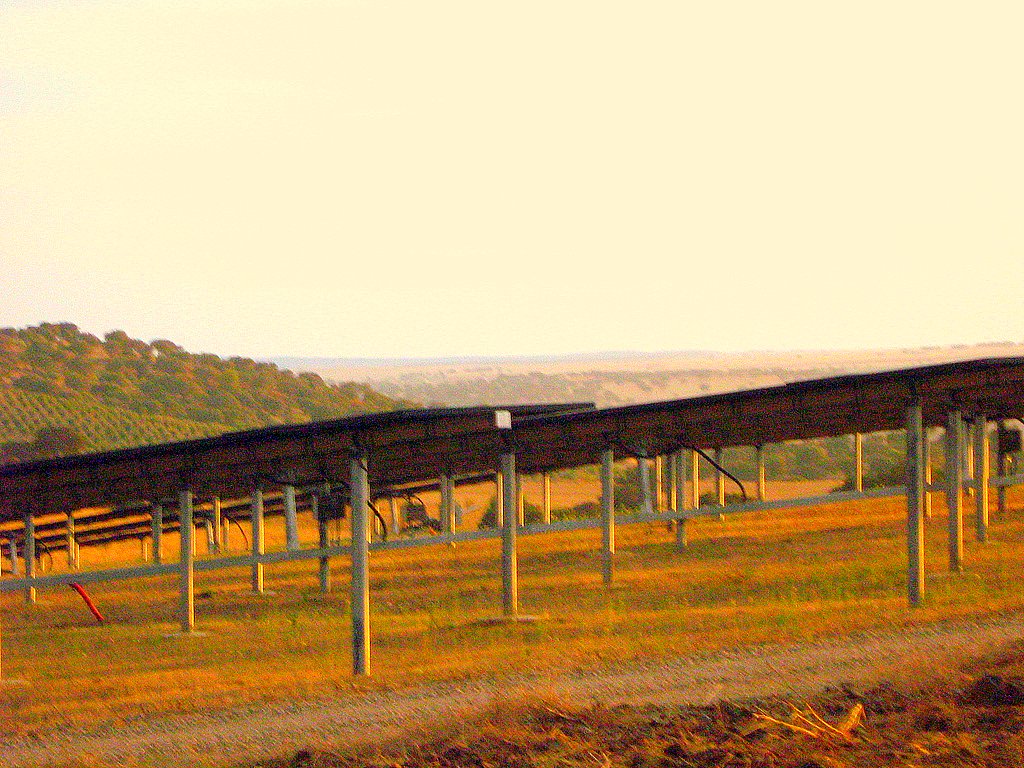
Serpa (Brinches) Photovoltaic Power Station [PICS]


Beginning of Autumn. At the end of a warm day - half an hour before the sunset and after having rolled across the spacious Alentejo’s plains - we finally get to the little village of Brinches. Next to a roundabout we find a rural road, which takes us through hills covered by vineyards and olive trees, typical of this soft landscape.

Read more


At one “corner” of the solar power station, we meet two men (a dog and some cows as well) who are contemplating the cloudy final of the day, uncommon this time of the year in one of the Iberian zones with the highest levels of solar radiation. In fact, these two men were the land owners, having rented their terrains to the GE Energy Financial Services, the project investor. What is very interesting in the Serpa project is the integration of clean power generation with the local agriculture.

They wonder about the huge quantity of energy daily injected in the electricity grid, as well as the fact the power plant being remotely controlled. The distance between the two PV power stations of Amareleja and Brinches is around 49 Km. During the construction there were many workers, but now the attentions are more focused on the “rival” Moura, the world's largest, after having dethroned Brinches this year.


Aerial view of Serpa solar power plant / renewableenergyworld.com

Brinches, Serpa, Portugal / Google Earth

Specifications of Serpa photovoltaic power station

Location: Portugal, Alentejo region, district of Beja, municipality of Serpa, parish of Brinches

Area occupied by power station: 60 ha

Installed rated power: 11 MWp

Annual electricity generation: > 18 GWh (equivalent to the consumption of
8,000 homes and farms in the region)

PV surface area: 34 ha

Number of PV panels: 52 000 (Sanyo, Sharp, SunPower and Suntech)

Solar tracking system: “PowerLight PowerTracker System”

Saving of more than 30,000 tons/year in greenhouse gas emissions compared to equivalent fossil fuel generation

Investment : 62 million euros

Conclusion: operational since January 2007

Project participants:
GE Energy Financial Services (Investor)
Power Light Corporation (Project and Construction)
Catavento, S.A. (Promoter and Asset Manager)


Photos by Luis Alves / www.flickr.com/photos/mokkikunta
(except the last two images)


This article is the part 5 of the article: “Alentejo: Solar Region”.

“Photovoltaic Solar in Portugal” - part 1 of the article: “Alentejo: Solar Region”
“Moura (Amareleja) Photovoltaic Power Station” - part 2 of the article: “Alentejo: Solar Region”
“Moura Renewable Energies Project“ - part 3 of the article: “Alentejo: Solar Region”The world’s largest photovoltaic power station [PICS] - part 4 of the article: “Alentejo: Solar Region”

allvoices

Monday, October 6, 2008

777 - Turbo-Capitalism's Failure


Dow closed at 10365.45, dropped 777.68, the largest drop ever in history - Sept. 29, 2008 (black Monday) / By faungg , Some rights reserved

Markets have inefficiencies, because of their inability to correct the negative externalities of industrial outputs (production) and industrial inputs (depletion of non-renewable resources). Failure to calculate the costs to nonparticipants in transactions and failure to allocate resources efficiently, represent market failure definitions.

Externalities represent cases of market failures. A person (or company) who makes choices that affect other people not accounted for in the market price – like the pollution costs often unaccounted for in industrial greenhouse gas emissions- is creating an externality.


Read more

Besides the externalities, non excludability and non rivalry are other common forms of market failure. To be efficient, markets should trade simultaneously both excludable and rival goods, and shouldn’t have externalities. In the market perspective, there are four types of goods: private goods (R,V), common goods (R, non-E), club goods (non-R,E) and public goods (non-R and non-E). [R-rival, E-excludable]

Excessive costs of excluding potential beneficiaries from the consumption of a rival natural or human-made resource, represent an inefficient market allocation - non excludability. Hence, "common" goods are defined by a property right regime in which only a collective body could exclude others from accessing rival resources, thereby allowing the capture of future benefits.

Stable “common property” regimes – suitable to the local level - must be based on certain principles which prevent the overexploitation of a resource system. However, these regimes are not the solution to large scale overuse , such as air pollution. In those situations, environmental regulations (economic impact estimated by cost-benefit analysis), quotas on pollution (tradeable emissions permits), taxes on pollution and adequate definition of property rights, might be preventive solutions to correct negative externalities.

Public goods are another type of market failure, because the market price doesn’t catch the social benefits of public provisions. For example, both social protection and environmental protection are inherently public goods, since their provision, in case of non-congestion, is non-rival and non-excludable, either protecting people from the risks of unemployment and illness or from environmental risks, like climate change.

If a public service faces problems of congestion or overuse, it will be a non-excludable but certainly a rivalrous good, making it a “common-pool resource”.

Privatization of public goods doesn’t change their intrinsic non-excludable, social and environmental characteristics. Nobody has the right to exclude people from protection, i.e., to prevent people who have not paid for the service, from receive its benefits .Most of public goods, like most of non-rival goods , are intangible, less fitted for an efficient private market.

Scarce, rivalrous, but also vital resources (like water) cannot be excludable. Water priced on a private market it would be the receipt to a humanitarian disaster, as the recent global market failures may prove.

With respect to local public services provision, the Finnish health care system is one of the most decentralized in Europe (as well as the other Nordic countries), with most of the Finnish people being generally satisfied with their national health care system. Local municipalities (Finnish: kunta) are the center of the system, largely public, where the private sector has little relevance today (only about 4% of Finnish doctors have a purely private activity) and the state has little intervention, defining goals and orientations. However, although the public health care and education, Finland has an advanced and competitive market economy.

According to Robin Hahnel (ecological economist), four environment related basic defects of a market economy can be enumerated: overexploitation of “common property” resources; overpollution; too little pollution cleanup; overconsumption. [ Hahnel (2005), pp66-72]

The view considering that markets are unable to correct negative externalities is in contradiction with the free-market environmentalist perspective. This perspective considers that both lack of ownership incentives to care for the property and multiplicity of ownership, represent the cause of overexploitation. In this point of view, pollution occurs because the property owners’ rights have not been totally respected and the legal authorities have inclination to favor big industry, public and common property over individuals and consumer organizations.

That approach also argue that resources are renewable and the market, by way of supply and demand, regulates consumption by adjusting it according to supply.The absence of sufficient incentives to create a potential “market” in a private economy, causes loss of efficiency, according to this view.

We can say that intrinsic characteristics of some type of goods, like the non-excludable goods (common goods and public goods), imply the design of sustainable social-environmental-economical systems, different from the private “markets”. See 1990 Ostrom's work about how people using real common property resources have worked to establish self-governing rules to reduce risks [Ostrom, E. 1990. Governing the Commons. Cambridge: Cambridge University Press]

Bailout of US financial system / Green Recovery / Low-Carbon Economy

These previous considerations are also appropriated for the financial markets, specially for institutions which utilize them. The recent dramatic intervention of the Federal Reserve, aimed at bailing out Wall Street with a US$700 billion plan, was a spectacular representation of market failure. In fact, the market took multiple decisions that would affect millions of tax-payers, who weren’t accounted for in the finance market price.

"Markets have inherent and well-known inefficiencies. One factor is failure to calculate the costs to those who do not participate in transactions. These 'externalities' can be huge. That is particularly true for financial institutions. Their task is to take risks, calculating potential costs for themselves. But they do not take into account the consequences of their losses for the economy as a whole. (…)
The unprecedented intervention of the Fed may be justified or not in narrow terms, but it reveals, once again, the profoundly undemocratic character of state capitalist institutions, designed in large measure to socialise cost and risk and privatize profit, without a public voice. “
Noam Chomsky, accuracy.org

The actual "turbo-capitalist" crisis, whose end and global consequences are unpredictable, could constitute an opportunity to the construction of a new alternative economic model firmly based on the environmental, economic and social domains, with new concepts of “growth” - not just a “green“ recovery based on this capitalist model, but a effective Low-Carbon Economy model.

However, a future green recovery may be compromised. The actual situation of financial collapse, with the state injecting hundreds of billions in the financial capitalist system, doesn’t assure the future application of funds on the environmental and social areas. It may even deflect these funds from many necessary and urgent investments in those areas.

Past Friday, 3 October 2008, the US House of Representatives voted in favour of a financial rescue plan after rejecting an earlier version. The approved package is aimed at buying up the bad debts of failing financial institutions on Wall Street, having the Treasury $700 billion to buy “toxic” mortgages, securities and related assets, that have undermined the US financial structure. But the deep causes of the US financial market collapse still continue unknown, and therefore this massive intervention probably cannot reach them.

So far “toxic” products are the justification for the financial market failure. However, financial products are increasingly designed trough technological innovation, which has replaced experienced professional traders by computers running software based on algorithmic trading, trying to simulate human behavior, deciding on timing, price and the final quantity of the orders. Although many claim an increased market efficiency with “robo trading” the last events could contradict it, and thus we could be in presence of a global technological (in)adaptation.

On September 29 2008, the Dow Jones lost 777.68 points, the largest one day point loss in its history, following news that the US House of Representatives had failed to pass the $700 bn bailout bill. Only after the Monday's 777-point stock-market slump the political class started to see the extension and deepness of the crisis. The “shock” and the claims from worried November potential voters motivated the Friday morning vote change. The bill that establishes the Emergency Economic Stabilization Act of 2008 - previously approved by the Senate, on October 1 2008 - was sent to the House, and on Friday, October 3, the House voted 263-171 to enact the bill into law.


References:
Wikipedia article, Environmental economics

Related articles:
From the US housing bubble to the (proposed) bailout of US financial system
Fed eyes Nordic Model

allvoices